Wednesday, July 2, 2014

Transformation Getting Prepped For Assessment

The Core Preparation...
This standard is really about being able to produce clearly three transformations that describe a picture.  To do this you must...

  1. Use the right works (reflect, rotate, enlarge, translate). 
  2. Include all the right elements.  For reflection its about mirror lines.  For rotation its about direction/degrees/centre of rotation.  For enlargement it is about scale factor (k) and centre of enlargement.  For translation it is about shifting my a vector run on top of rise.
  3. Have a really clear drawing with identification of the things that you've done. 
  4. Have really clear sentence instructions... "first do this, then do that...".
Here is a web address that has five actual assessments (scroll down to 1.9).
http://ncea.tki.org.nz/Resources-for-Internally-Assessed-Achievement-Standards/Mathematics-and-statistics/Level-1-Mathematics-and-statistics

As a group we're going to have a look at the one called "Geometric Gardens".  Remember that you'll need to have access to a protractor, compass, ruler, pencil and rubber. 


Tuesday, July 1, 2014

Transformation Post 6

Enlargement
This transformation is exactly what it sounds like.  It is when we enlarge the object. 

I always think of enlargement transformations a bit like a shadow puppet.  There are there three things in play... 
There must be an object (in this case the hands). 
There must be an image (the shadow), and,
Finally there must be a source of light (we call this the centre of enlargement). 

The mathematics here is the idea of a scale factor (how many times as big the image will be that the object).  In this deer picture the shadow is about 1.5 times the size of the hands... this means there is a scale factor of 1.5. 

In ncea level one we use the symbol k for scale factor.  So the deer shadow would be an enlargement k = 1.5. 

 
Note that there is a possibility of a fraction enlargement (which makes it smaller).  That is when k is a fraction.  You won't need this for Achieve. 

Monday, June 30, 2014

Transformation Post 5

Translation = Shift About the Page

The third type of transformation (remember to pass NCEA you need to successfully use three different transformations) is called translation. 

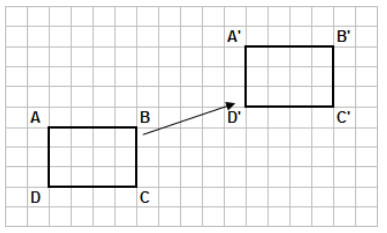
A translation is when the object (ABC) is moved around the paper, it is kept the same.  ie not rotated, flipped, shrunk or enlarged. 

Here is a picture of what I mean. 

Can you see that the rectangle is really not changed, just shifted.

You can see that the rectangles are clearly labelled as object ABCD and image A'B'C'D'

The trick here is to be able to see how it's moved - in this case up and to the right.  We have to use the right mathematical code for this.  This is the bit year 11's can get stuck on.  We are going to use a vector.  think Despicable Me Villain - he picks his name from maths... listen. 


Basically the bit that you need to know is how to show a translation.  For this you need to numbers that represent the direction (left/right) and the magnitude (up down).  In the above picture of the rectangles.  I can see that the point A going to A' has gone up 4 and to the right 9.  These are the numbers you need. 

Here is a clear YouTube to explain this...


Sunday, June 29, 2014

Hello

Good to see you guys today.  This post is a place where you can ask me questions or give me some feedback.  You'll need to be pretty proactive with this unit as it's a tight squeeze. 
Thanks Mr Harper

Transformation Post 4

Rotation. 

Rotation is an important transformation for you to have solid understandings with.  A rotation is just when we spin the object (remember objects have labels like ABCD or PQRS). 

When we rotate we have to know three main things...
  1. Which direction - there are two clockwise or anti-clockwise.
  2. How many degrees - remember that a right turn is 90 degrees.
  3. Where is the 'centre of rotation' - this is the anchoring point that the image is "swung around".
 You will need a protractor to carefully measure the size of the angles you are rotating. 

A trick is to think of Spiderman and his web.  Think of Spiderman sitting at the 'centre of rotation' - he fires his webs out onto an object and then rotates/spins them around him. 

Another trick is to use some clear overhead transparency paper and a compass point to pin down the centre of rotation. 

The final trick is that if the instructions just say rotate ABC 90 degrees around point A.  see there is no direction given.  Then we just make the decision to go anticlockwise

Thursday, June 26, 2014

Transformation Post 3

Reflections

The first of the transformations we come to is reflection.  As the name suggests this is all about using mirrors to find a new shape. 

One definition that we need is the idea of an 'Object' and an 'Image'.  The object is the original and the image is the copy/reflection.  In maths we use codes for these.  An object is given capital letters... like a triangle called ABC (three letters for three corners/vertices)... an image is given the same letter with a dash like a reflected triangle called A'B'C'.  Those dashes show it's the reflection. 

Here is my PowerPoint on this. 


Here is a video that shows this...

Transformations Post 2

Basic Introduction to Assessment 91034 1.9 Transformations

Transformations is a two credit internal assessment at Level One. It is a paper that is based on your abilities to create neatly two dimensional representations (those that are good at art of graphics generally love this standard). That is you draw on flat paper a picture (really basic shapes) following a set of instructions in order.
 
You will need to have access to the following equipment; sharp pencils, rubber, rulers, compass and protractor. Having a little mirror is also a helpful thing too....

When we do our drawing we have to show our construction lines (these are the 'shadow' pencil lines that we use). 

In this standard you will need to be super accurate in your presentation - make sure that your written work is looking awesome.

Transformations Post One

Basic Introduction to Assessment 91034 1.9 Transformations

Transformations is a two credit internal assessment at Level One. It is a paper that is based on your abilities to create neatly two dimensional representations (those that are good at art of graphics generally love this standard). That is you draw on flat paper a picture (really basic shapes) following a set of instructions in order.
You will need to have access to the following equipment; sharp pencils, rubber, rulers, compass and protractor. Having a little mirror is also a helpful thing too.
The basic gist of this unit is that you will be given a step by step set of instructions to follow. These will ask you to slowly and methodically create a drawing (it will be a basic ‘block like’ picture). You may be asked to write some instructions for a basic shape that you’ve made.

Here is a link to http://www.studyit.org.nz where there is a lot of information that will also help you... http://www.studyit.org.nz/subjects/maths/math...